The Poetry of Streets through Light and Shadow

Street photography is my personal zen. While others seek meditation in silent rooms or peaceful gardens, I find my deepest state of mindfulness in the pulsing arteries of urban life. It's a beautiful paradox that took years to understand – how the chaotic dance of city streets could lead to such profound inner quiet. But that's the essence of this art form. Where documentary photographers chase reality as their ultimate target, we street photographers use reality as a tool, transforming the concrete world into abstract poetry.

Berlin

As a Leica Ambassador and Akademie instructor, I've spent countless hours exploring this intersection of inner peace and outer chaos. The morning light cascades down Rome's narrow vicoli, casting long shadows across weathered cobblestones, and in these moments, the city becomes both canvas and teacher. With my Leica Q3 in hand, I wander through the labyrinth of the eternal city, seeking those fleeting instances where light, life, and geometry align in perfect harmony.

Rome is my laboratory, a living museum where every corner tells countless stories spanning millennia. Here, urban photography takes on a different meaning – it's not just about documenting city life, but about capturing the delicate dance between ancient stones and modern souls. The same walls that witnessed emperors now frame contemporary scenes of daily life, creating a natural stage for candid photography that transcends time.
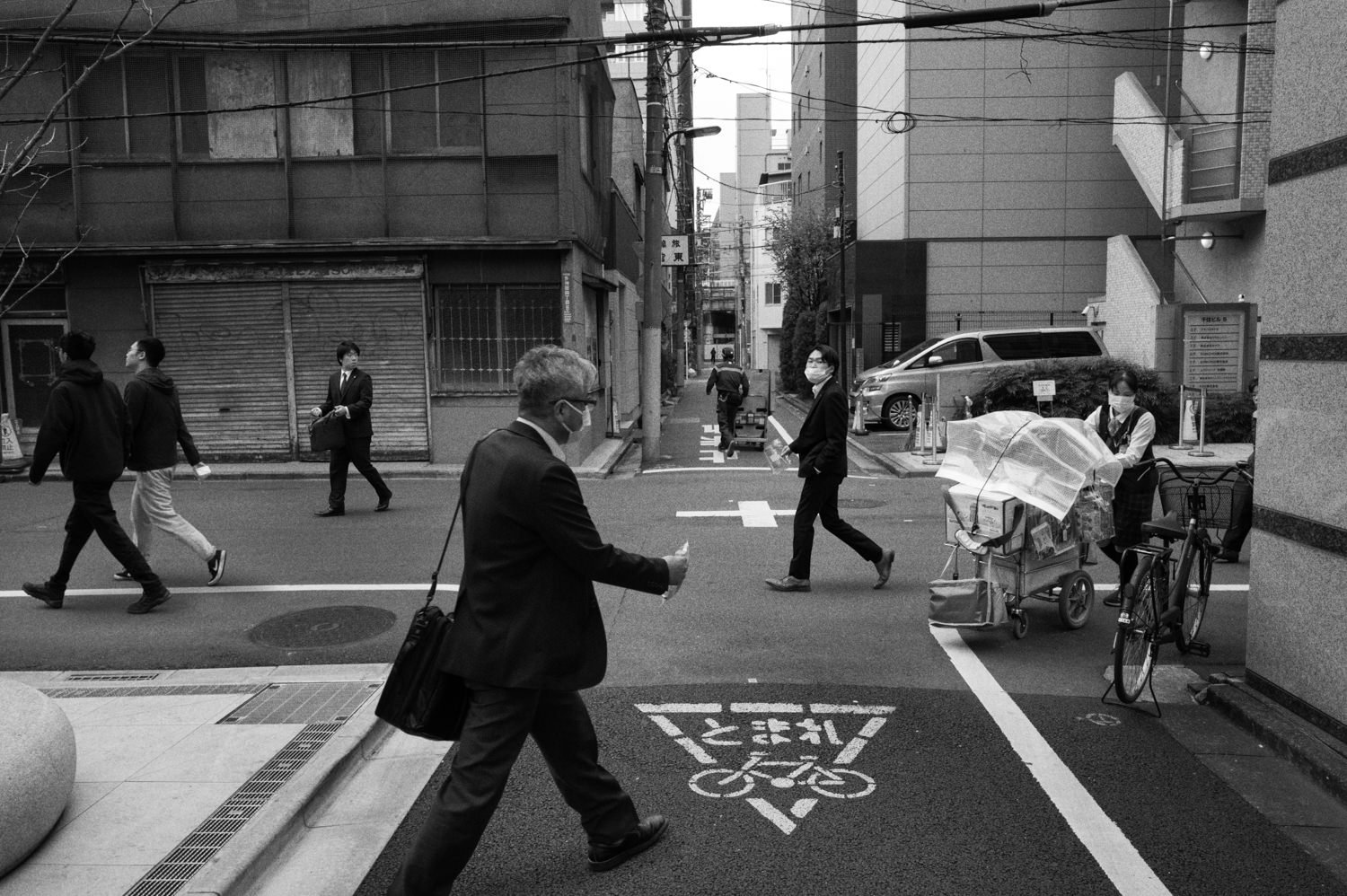
Tokyo

I've learned to see the city through the contemplative eye of my Leica M11P, working consistently at f/11 – a technical choice that transforms the streets into a canvas where everything from two meters to infinity remains crystal clear. This mastery of hyperfocal distance has become second nature, allowing my mind to focus entirely on composition and timing rather than technical adjustments. The camera becomes an extension of consciousness, a tool for meditation rather than mere documentation.

Hong Kong

Each city has its own rhythm, its own breath, its own soul. Naples, with its raw authenticity and unapologetic character, pulses with a different energy than Milan's sophisticated elegance. In Naples' Spanish Quarter, street photography becomes a visceral experience – the challenge isn't finding moments, but choosing which ones to capture among the countless scenes unfolding simultaneously. Milan, by contrast, requires patience and precision, waiting for those perfect instances when the city's polished facade reveals glimpses of genuine humanity.

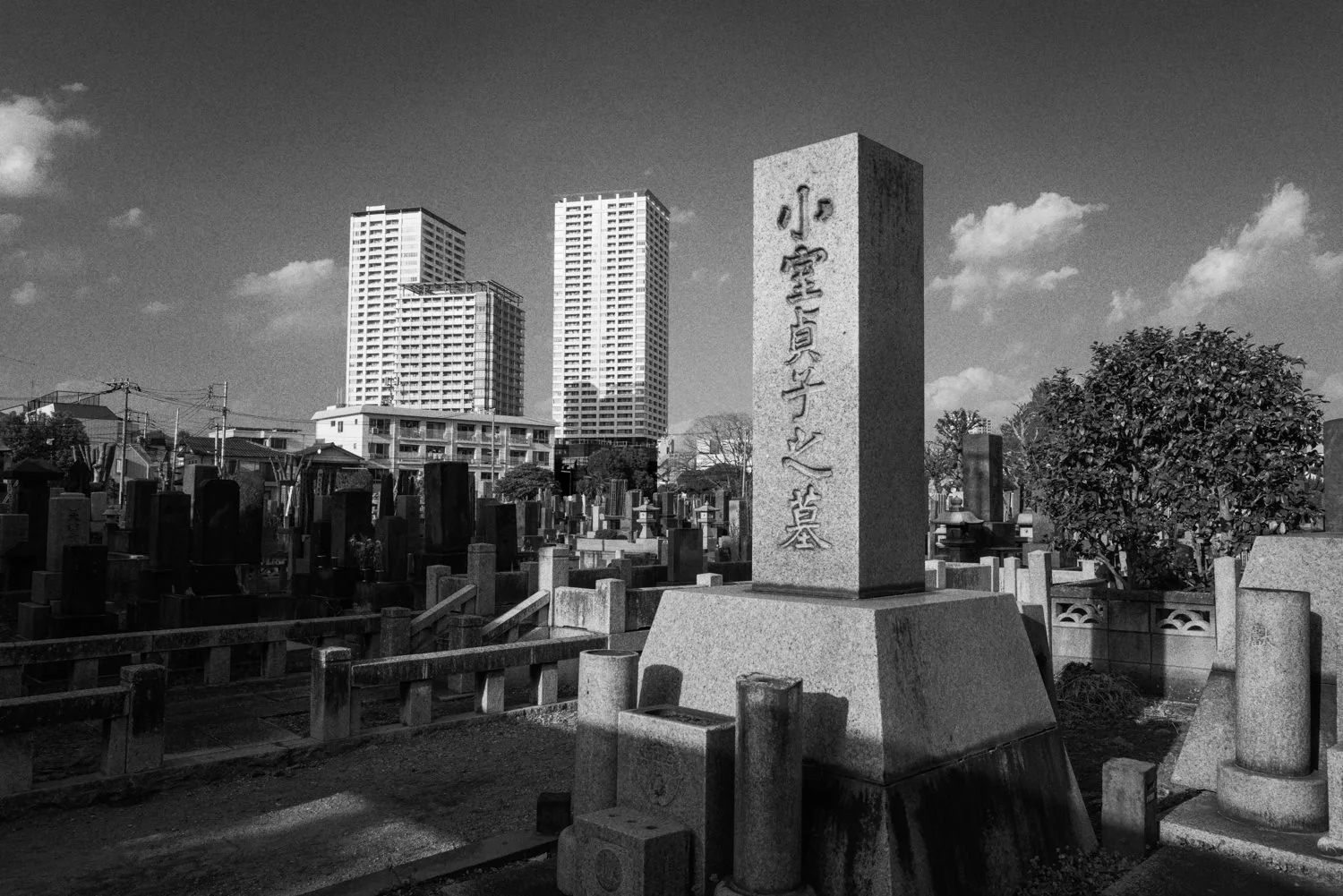
Twice a year, my journey takes me to the neon-lit streets of Tokyo and the vertical labyrinths of Hong Kong. These Asian metropolises offer an intoxicating contrast to Italian street life. In Tokyo, black and white street photos take on new meaning – the interplay of artificial light and shadow creates an almost cinematic quality, while Hong Kong's dense urban canyons frame decisive moments in steel and glass. Each city offers its own lessons in seeing, in patience, in the art of waiting for moments to unfold.
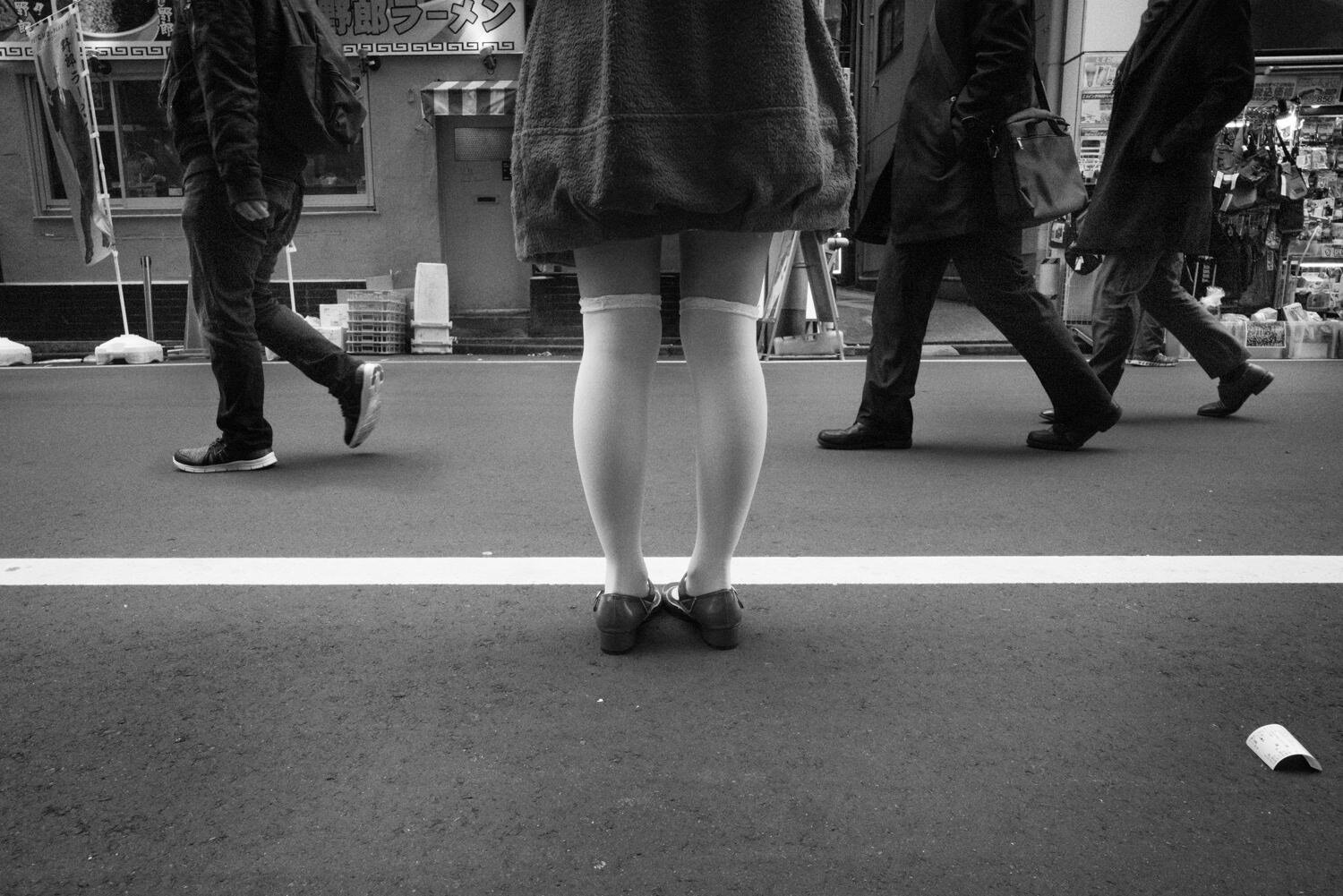
Tokyo

Street portraits have become a particular expression of this meditative approach. There's an intimate magic in these encounters – brief connections formed through a shared glance, a subtle nod, a silent understanding between photographer and subject. The Leica Q3's discrete presence helps in these moments, allowing me to capture authentic expressions without disrupting the natural flow of street life. These aren't just portraits; they're moments of shared humanity, frozen in time.

The essence of street photography lies in what Henri Cartier-Bresson called the decisive moment – that split second when all elements align to tell a complete story. But finding these moments isn't about luck or mere observation. It's about developing an intuition for city life photography, about understanding the subtle rhythms of urban spaces. Over time, you begin to anticipate when and where these moments might occur, positioning yourself not where the action is, but where it will be. This is where the zen of street photography becomes most apparent – in the quiet anticipation, in the mindful waiting, in the instant recognition of the extraordinary within the ordinary.
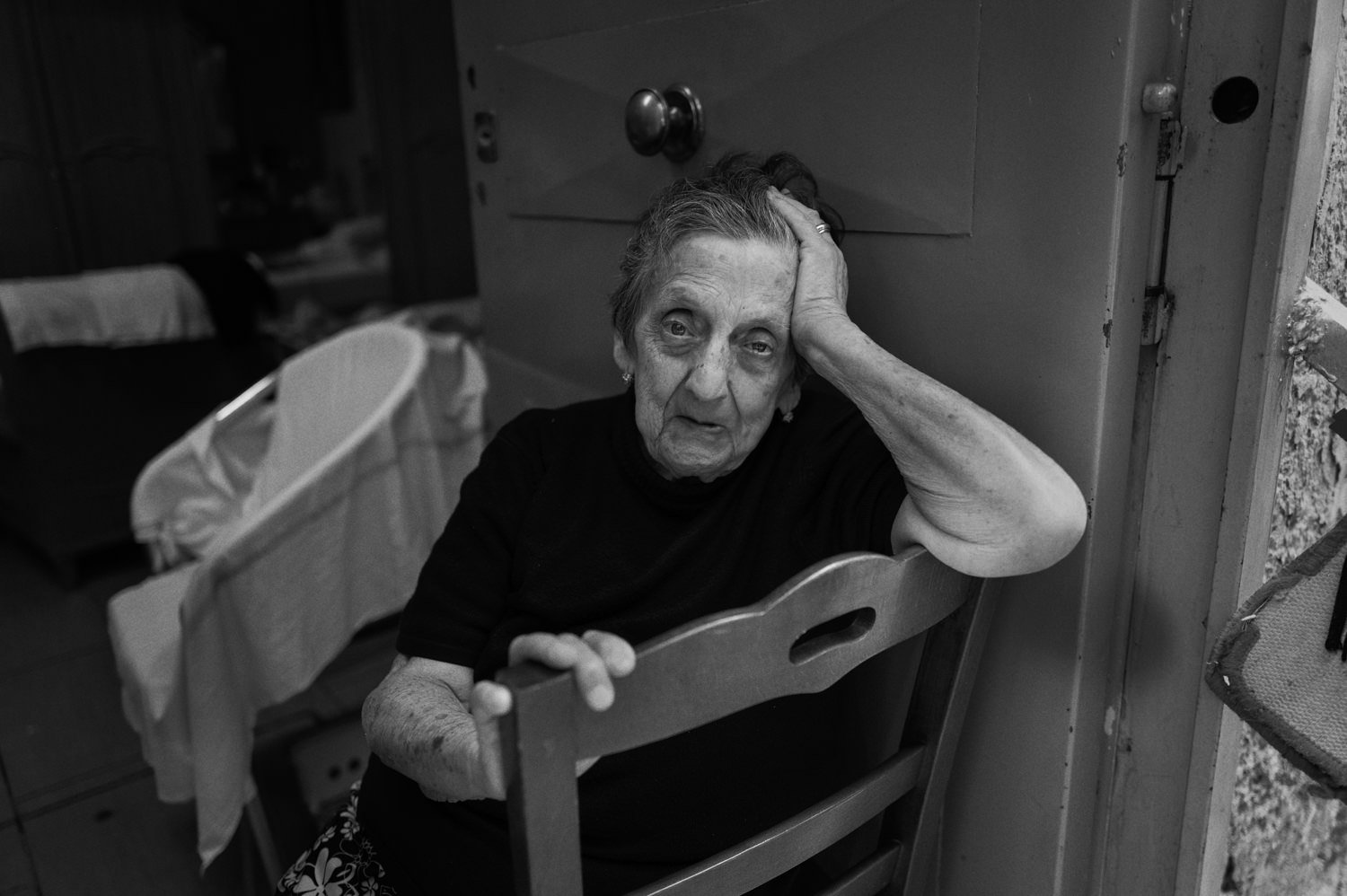
Naples

Through my work as a Leica Akademie instructor, I've had the privilege of sharing these insights with photographers from around the world. I often tell my students that while technical mastery is important – understanding street photography camera settings, knowing your tools intimately – the real art lies in developing your eye, in learning to see the extraordinary in the ordinary, in finding street photography inspiration in the seemingly mundane moments of daily life.

The process is meditative. Walking the streets of Rome at dawn, I often find myself in a state of heightened awareness, where every shadow, every gesture, every interaction becomes potential poetry. The early morning light paints the city in soft gradients, transforming ordinary scenes into extraordinary photographs. These are the moments when the city reveals its secrets, when the careful observation of urban life yields its most precious rewards.
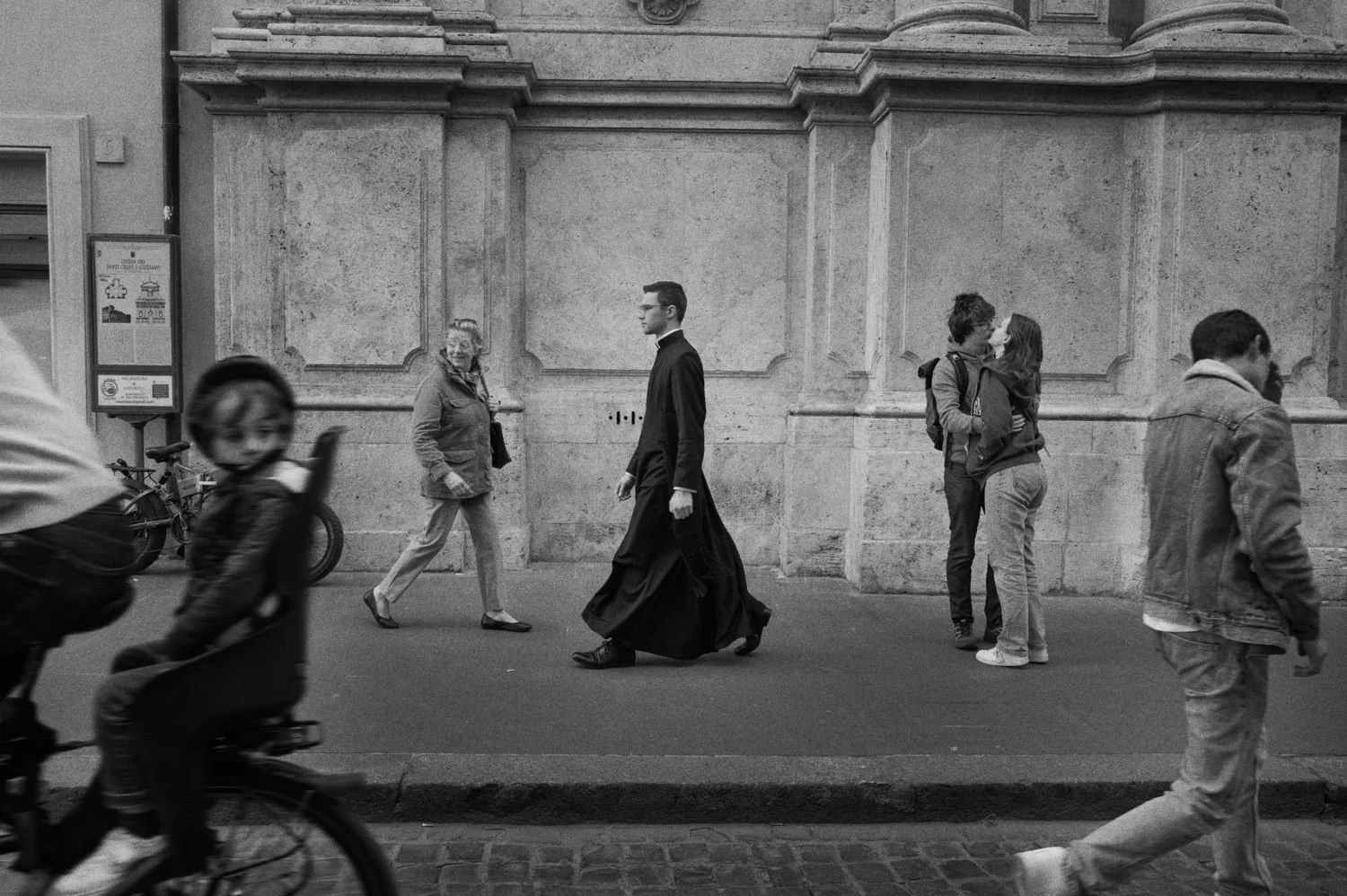
Rome

This abstract approach to reality sets street photography apart from other forms of visual storytelling. While photojournalists and documentary photographers strive to capture truth in its most literal form, we street photographers seek to distill truth from the seemingly ordinary moments of daily life. We're not bound by the need to tell specific stories or document particular events. Instead, we're free to explore the space between reality and perception, finding universal truths in fleeting moments.

As the sun climbs higher, the character of the streets changes. The quiet contemplation of dawn gives way to the bustling energy of day. This is when candid photography becomes most challenging – and most rewarding. In these moments, the city becomes a stage, and every passerby an actor in an unscripted performance. My role is simply to recognize and capture these fleeting narratives, to find poetry in the prosaic.
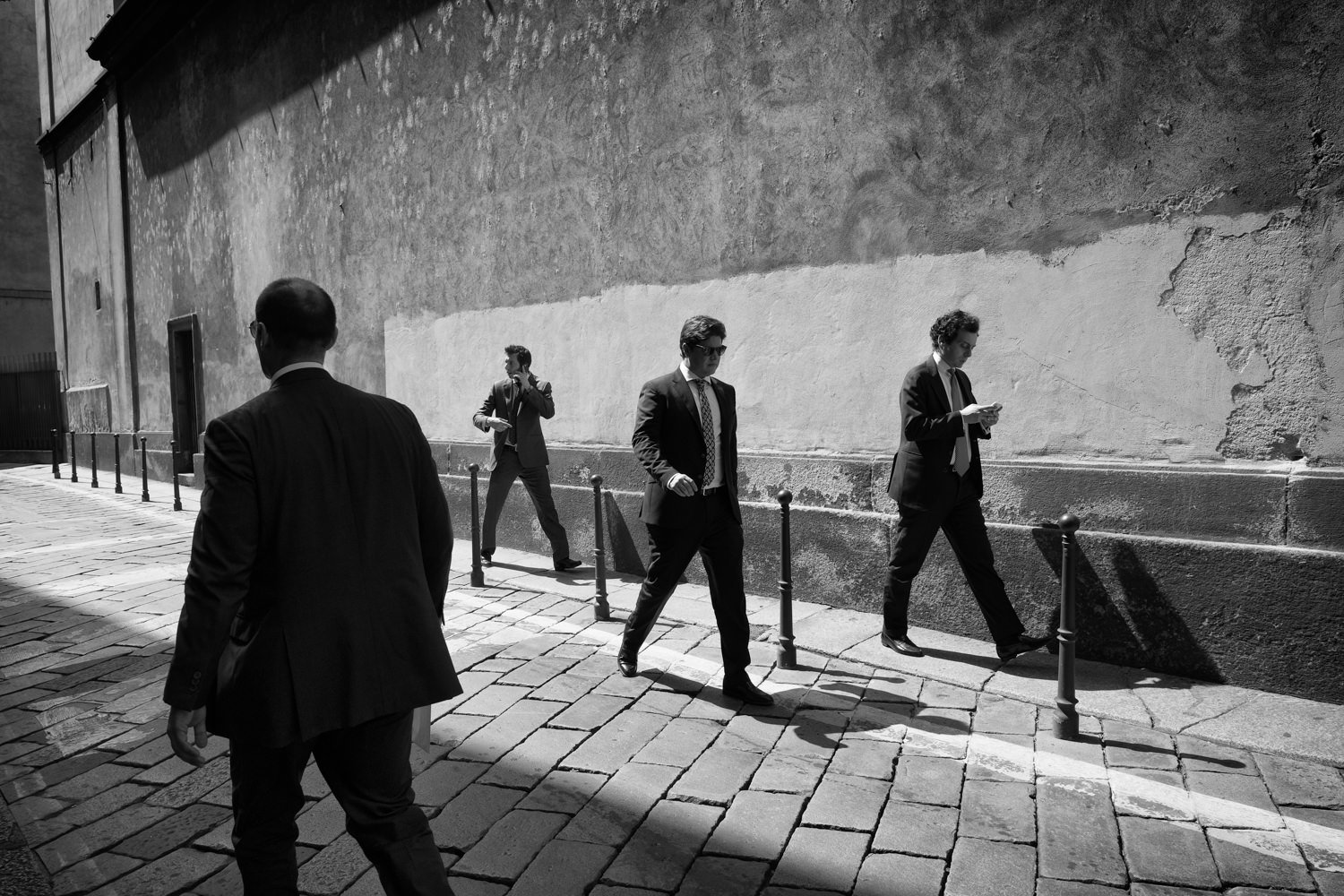
Milan

The tools matter – the reliability of my Leica M11P, the versatility of the Q3 – but they're secondary to the development of a photographic vision. These cameras have become extensions of my eye, allowing me to work almost instinctively, focusing on the poetry of the moment rather than the mechanics of capture. It's not about the camera; it's about the way we see the world through it.

As the day wanes and the streets empty, I often find myself reflecting on the privilege of this pursuit. Street photography is more than documentation – it's a way of seeing, of understanding, of connecting with the world around us. Every frame captured tells a story, not just of the moment photographed, but of the photographer's journey to that moment, both physical and spiritual.
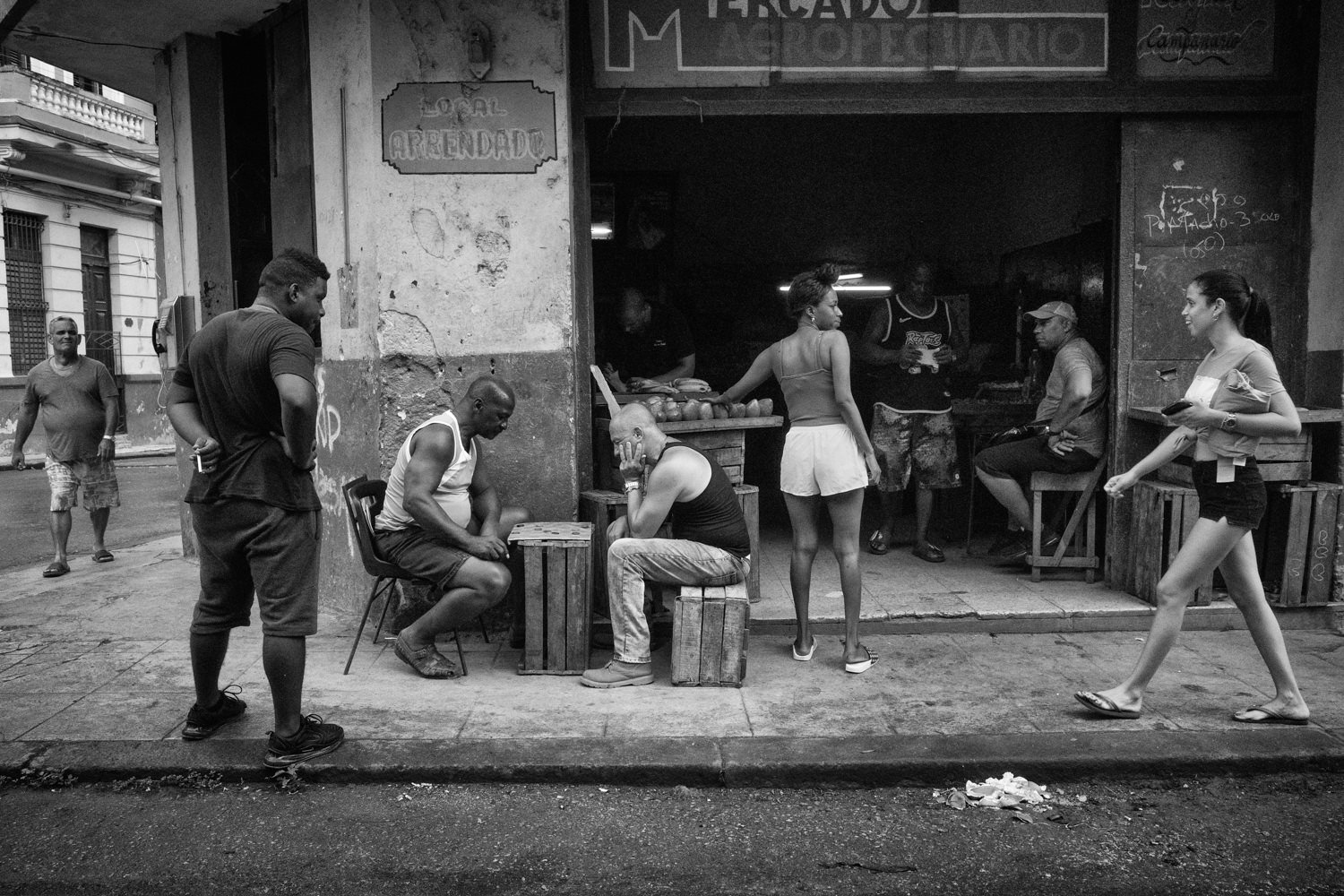
Havana

For those drawn to this art form, remember that every great street photograph is the result of countless hours spent walking, watching, and waiting. The streets are always teaching, always changing, always offering new perspectives to those patient enough to look for them. Whether you're photographing in the familiar corners of your hometown or exploring distant cities, the key is to remain open to the possibilities that each moment presents.

Budapest

The journey never ends. Tomorrow, the light will paint new shadows across Rome's ancient stones, Tokyo's streets will pulse with different rhythms, and somewhere, in the chaos of Naples or the order of Milan, countless decisive moments await discovery. Our role, as street photographers, is simply to be there, present and aware, ready to capture these fleeting moments of beauty and truth. This is our meditation, our practice, our way of making sense of the world – one frame at a time.
Tokyo in Black and White: A Leica Photographer's Journey Through Street Photography

Stepping into Tokyo feels like entering a monochromatic symphony where every note is a blend of history and futurism, tradition and innovation. The city unfolds like a black-and-white photograph, rich in contrast and depth, revealing new details the longer you look. As I wander through its intricate streets with my Leica cameras—the Q3 with its 28mm lens for capturing expansive contexts and candid portraits, and the M11-P with a 50mm lens for more intimate portraiture—I am constantly reminded why Tokyo is, perhaps, my favorite city in the world for street photography.

Photography by Stefania Matteo

My connection to Japan runs deep, rooted in the pop culture that shaped my childhood. Growing up immersed in the anime and manga of the 70s and 80s, Tokyo was not just a distant metropolis but a vibrant world that fueled my imagination. Those stories and images imprinted themselves on my psyche, fostering a lifelong fascination with Japanese culture and way of living. The love for technology that permeates Tokyo aligns seamlessly with my own interests, creating a sense of harmony every time I visit.

Twice a year, I have the privilege of sharing this passion through workshops I organize in Tokyo, one with the esteemed Leica Akademie and another alongside my friend, the renowned photographer Steve McCurry.

These gatherings are more than educational experiences; they're journeys into the heart of a city that never ceases to inspire. Together with fellow photographers, we explore Tokyo's multifaceted streets, capturing moments that speak to the soul of the city.

Tokyoites—the term foreigners often use for the people of Tokyo—appear to be in constant motion, moving with a purpose that is both mesmerizing and elusive. They navigate the bustling streets with eyes often fixed on their smartphones, creating a fascinating juxtaposition of presence and absence. This observation sparked my long-term project, Tokyoites, where I aim to capture the unique concept of personal space in one of the world's most densely populated cities.

In my earliest trip to Tokyo as a child, I didn't have a camera, but the city's imagery etched itself into my memory. The allure of Tokyo lies in its endless contrasts: countless lifestyles, diverse districts, and the seamless blend of old and new. It's a city composed of many smaller cities, each in constant flux. Through the lens of a Gaijin—an outsider—I strive to capture these nuances in black and white, emphasizing the stark contrasts and subtle shades that color often conceals.

The residents of Tokyo have mastered the art of isolation amidst the crowd. They can stand alone against a wall to answer a call or consult a map, carving out personal space in the sea of humanity. This delicate balance between communal harmony and individual solitude fascinates me. In Tokyo, what might seem like a limitation becomes a virtue—a necessary adaptation that allows over 16 million people to coexist harmoniously. The citizens move like dancers in a meticulously choreographed performance, navigating streets and stations without collision or conflict.

Through my photography, I aim to capture this silent dance. The loneliness I perceive here isn't bleak; it's a quiet, almost poetic sentiment woven into the fabric of daily life. Each black-and-white image stands alone, a singular narrative frozen in time. Yet, when viewed collectively, they form an unexpected mosaic of moments that reflect my journey through Tokyo's complex reality.

25 Locations for Black-and-White Street Photography in Tokyo:

  1. Shibuya Crossing: The world's busiest pedestrian intersection, where the orchestrated chaos of thousands crossing at once becomes a mesmerizing tableau. The black-and-white medium accentuates the patterns and movement, highlighting the anonymity within the crowd.

  2. Asakusa and Senso-ji Temple: A district where ancient traditions meet the present. The temple's timeless architecture juxtaposed with bustling markets offers rich contrasts, perfect for capturing the soul of old Tokyo.

  3. Akihabara: Known as "Electric Town," it's the epicenter of technology and pop culture. The stark lines of electronic storefronts and the energy of enthusiasts create dynamic scenes that shine in monochrome.

  4. Harajuku's Takeshita Street: A hub of youth culture and fashion, where individuality bursts forth. Black-and-white photography emphasizes the textures and styles, focusing on the expressions and interactions of Tokyo's vibrant youth.

  5. Golden Gai in Shinjuku: A network of narrow alleys lined with tiny bars. The intimate spaces and eclectic patrons provide a wealth of character studies, enhanced by the play of light and shadow in black and white.

  6. Shimokitazawa: A bohemian neighborhood with vintage shops, indie music venues, and a relaxed atmosphere. The maze of narrow streets and eclectic crowd make it ideal for capturing candid moments that reflect Tokyo's creative and alternative scene.

  7. Yanaka Ginza: A traditional shopping street that seems frozen in time. The old wooden facades, local artisans, and friendly shopkeepers create nostalgic scenes reminiscent of Tokyo's past, perfect for black-and-white compositions that evoke a sense of nostalgia.

  8. Nakameguro: With the Meguro River running through it, this area is serene and stylish. The interplay of light filtering through trees and reflections on the water make for compelling monochromatic compositions, especially during the cherry blossom season.

  9. Kichijoji and Inokashira Park: A blend of urban life and natural beauty. The park's tranquil setting juxtaposed with the lively surrounding streets offers diverse photographic opportunities, capturing the harmony between city dwellers and their environment.

  10. Tsukiji Outer Market: A bustling marketplace alive with vendors and shoppers. The textures and expressions captured here are rich in detail, revealing the everyday rhythms of the city and the vibrancy of local commerce.

  11. Ginza: Tokyo's upscale district known for luxury and elegance. The sleek architecture, high-end boutiques, and sophisticated pedestrians provide a stark contrast ideal for black-and-white imagery that highlights modernity and affluence.

  12. Omoide Yokocho (Memory Lane): An alleyway of small eateries in Shinjuku. The intimate setting, warm interactions between people, and the glow from lanterns create heartfelt scenes that capture the essence of Tokyo's nightlife.

  13. Ueno Park and Ameya-Yokocho Market: Ueno Park offers cultural institutions and open spaces, while nearby Ameya-Yokocho is a bustling market street. The contrast between tranquility and hustle provides varied scenes for street photography.

  14. Tokyo Station and Marunouchi Area: Historic architecture meets modern skyscrapers. The station's red brick facade against the backdrop of glass towers highlights Tokyo's architectural evolution, offering strong lines and contrasts in black and white.

  15. Shinjuku Gyoen National Garden: An oasis in the urban jungle. The garden's landscapes and the contrast between natural forms and the distant skyline offer serene compositions that reflect the balance between nature and urban life.

  16. Korean Town in Shin-Okubo: A vibrant neighborhood known for its Korean shops, restaurants, and pop culture influence. The lively streets and diverse crowd provide dynamic scenes that showcase Tokyo's multicultural facets.

  17. Koenji: A district famous for its vintage clothing stores, music scene, and street art. The gritty textures and artistic flair of Koenji make it a compelling location for capturing Tokyo's subcultures in monochrome.

  18. Ameya-Yokocho (Ameyoko) Market in Ueno: A bustling open-air market with a post-war atmosphere. The narrow lanes filled with vendors selling everything from seafood to clothing offer rich textures and lively interactions ideal for black-and-white photography.

  19. Kawasaki Warehouse (Anata no Warehouse): Though recently closed, this unique arcade recreated the atmosphere of Hong Kong's Kowloon Walled City. If accessible, its gritty, cyberpunk aesthetic provides a dramatic backdrop for evocative images.

  20. Odaiba: A man-made island with futuristic architecture and wide-open spaces. The minimalist lines and expansive views offer opportunities to capture the modernist side of Tokyo, with structures like the Rainbow Bridge and Tokyo Big Sight.

  21. Kagurazaka: A district known for its old geisha houses, narrow cobblestone streets, and French influence. The blend of traditional and European elements creates a unique atmosphere that translates beautifully into monochrome imagery.

  22. Ebisu and Daikanyama: Stylish neighborhoods with trendy cafes, boutiques, and a relaxed vibe. The sophisticated atmosphere and architectural details offer scenes that highlight Tokyo's cosmopolitan side.

  23. Tsukishima Monja Street: Famous for its monjayaki restaurants, this area has a retro charm with low-rise buildings and traditional eateries. The intimate street scenes provide a glimpse into the culinary culture of Tokyo.

  24. Ikebukuro's West Side: Less frequented by tourists, this area has a mix of local shops, quiet residential streets, and occasional pockets of hustle. It offers a more subdued yet authentic slice of Tokyo life.

  25. Fukagawa Area: Rich in history with old temples and shrines. The calm streets and traditional architecture provide a serene backdrop for capturing the spiritual side of Tokyo.

Each of these locations adds a new layer to the intricate tapestry of Tokyo. From vintage markets to multicultural neighborhoods, the city's diversity is a treasure trove for black-and-white street photography. The monochrome medium strips away the distraction of color, allowing the essence of the scene—the textures, contrasts, emotions—to emerge with clarity and power.

By exploring these varied locales, I continue to uncover the countless stories that Tokyo has to offer. The city remains an endless source of inspiration, inviting me—and those who join me on my workshops—to delve deeper into its enigmatic allure. Whether it's the silent contemplation of a lone individual amidst the crowd or the bustling energy of a market street, Tokyo in black and white reveals the profound beauty of everyday life in a metropolis like no other.

Visit my Tokyo Street Photography Gallery