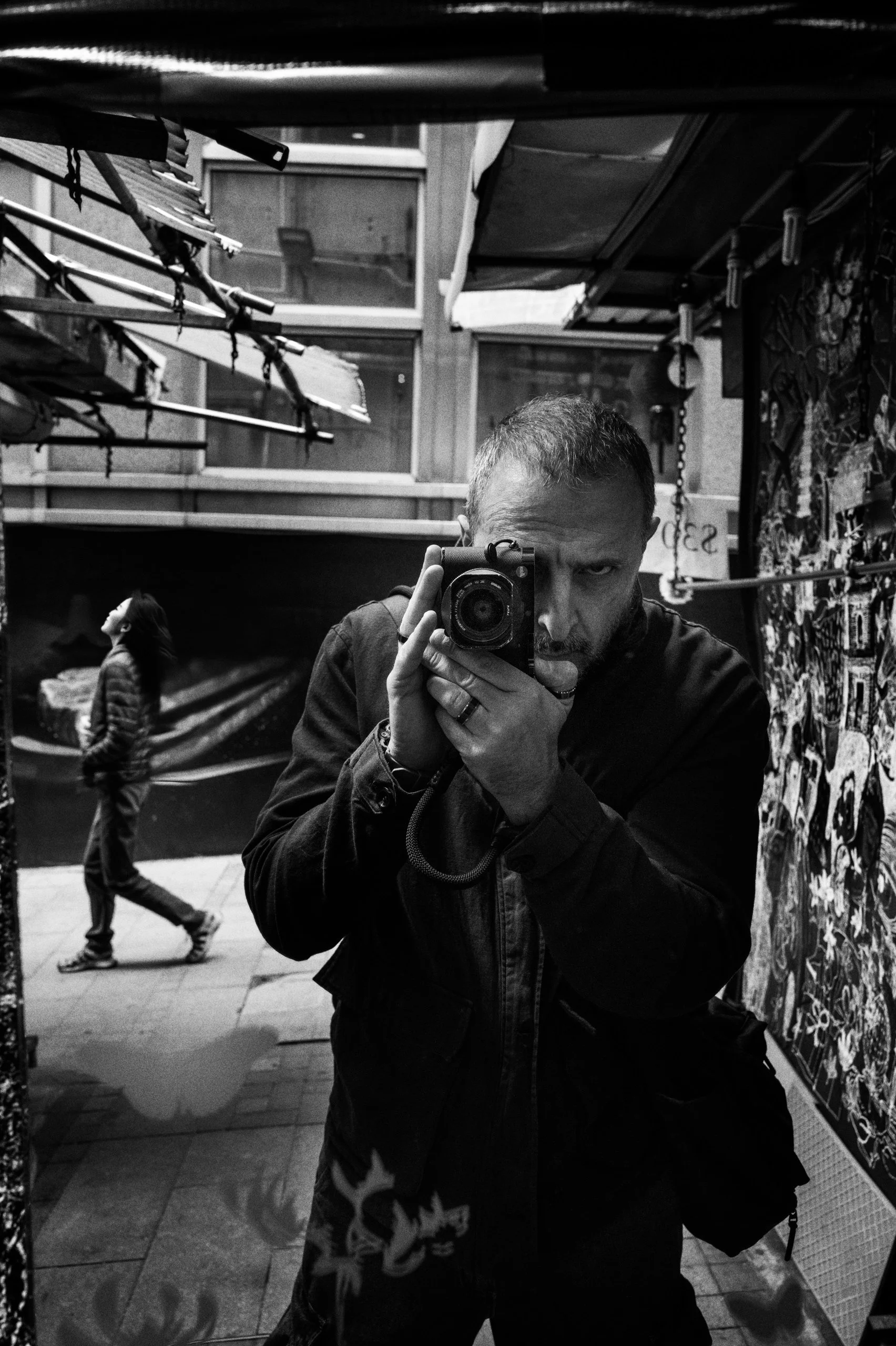
There is something deeply paradoxical about the street self-portrait. On one hand, street photography is historically the art of detached observation, the gaze that captures the world without modifying it. On the other, the self-portrait is the most intimate and openly subjective act a photographer can perform. Yet when these two worlds meet – when the photographer decides to insert themselves into the urban scene – something extraordinary happens: the observer becomes simultaneously observed, the witness becomes protagonist, and the street becomes a mirror in both the most literal and metaphorical sense.
A Hidden Tradition
The self-portrait in street photography has roots as ancient as the medium itself. Vivian Maier, in her countless self-portraits captured in the reflections of Chicago storefronts, wasn't simply documenting her physical presence. She was constructing a silent dialogue between the self and the city, between private identity and public space. Her self-portraits – often involuntary in their spontaneity, yet so deliberate in composition – reveal an acute awareness of the photographer as an integral part of urban theater.
Lee Friedlander elevated this practice to a conscious art form. His shadow stretching across New York sidewalks, his reflection fragmented in the metallic surfaces of automobiles, are not mistakes or accidental intrusions. They are philosophical statements: "I was here. I saw this. My presence modified this moment." Friedlander taught us that the photographer can never be truly invisible, that every image carries within it the trace of who created it.
More recently, Satoki Nagata has transformed Tokyo puddles into dimensional portals, where sky and city merge in compositions that defy gravity and perspective. His aquatic self-portraits are not simple games of reflection: they are Zen meditations on the ephemeral nature of reality, on the relationship between what is solid and what is illusory.
Philosophy of Reflection
But why dedicate an entire section of my work to street self-portraits? The decision came after years of reflection – literally and metaphorically.
When we photograph others on the street, we maintain a certain emotional distance. We are hunters of moments, collectors of others' instants. But when we insert ourselves into the frame, when we seek our shadow on the pavement or our reflection in a puddle, something changes radically. We become vulnerable. Street photography, typically a shield behind which to hide, becomes a mirror in which to reflect.
There is a Zen principle that has always fascinated me: the idea that the true self can only be understood through its reflection in the world. We cannot see our own face directly – we need a mirror, a reflective surface, a mediator. Similarly, perhaps we can better understand our nature as photographers only by physically inserting ourselves into the scenes we capture, openly admitting our presence rather than feigning an impossible objectivity.
The street self-portrait is also an act of radical honesty. It says: "I'm not pretending to be invisible. I'm here, walking these streets like everyone else. The difference is that I carry a camera, and this changes the way I see and am seen."
Techniques and Poetics
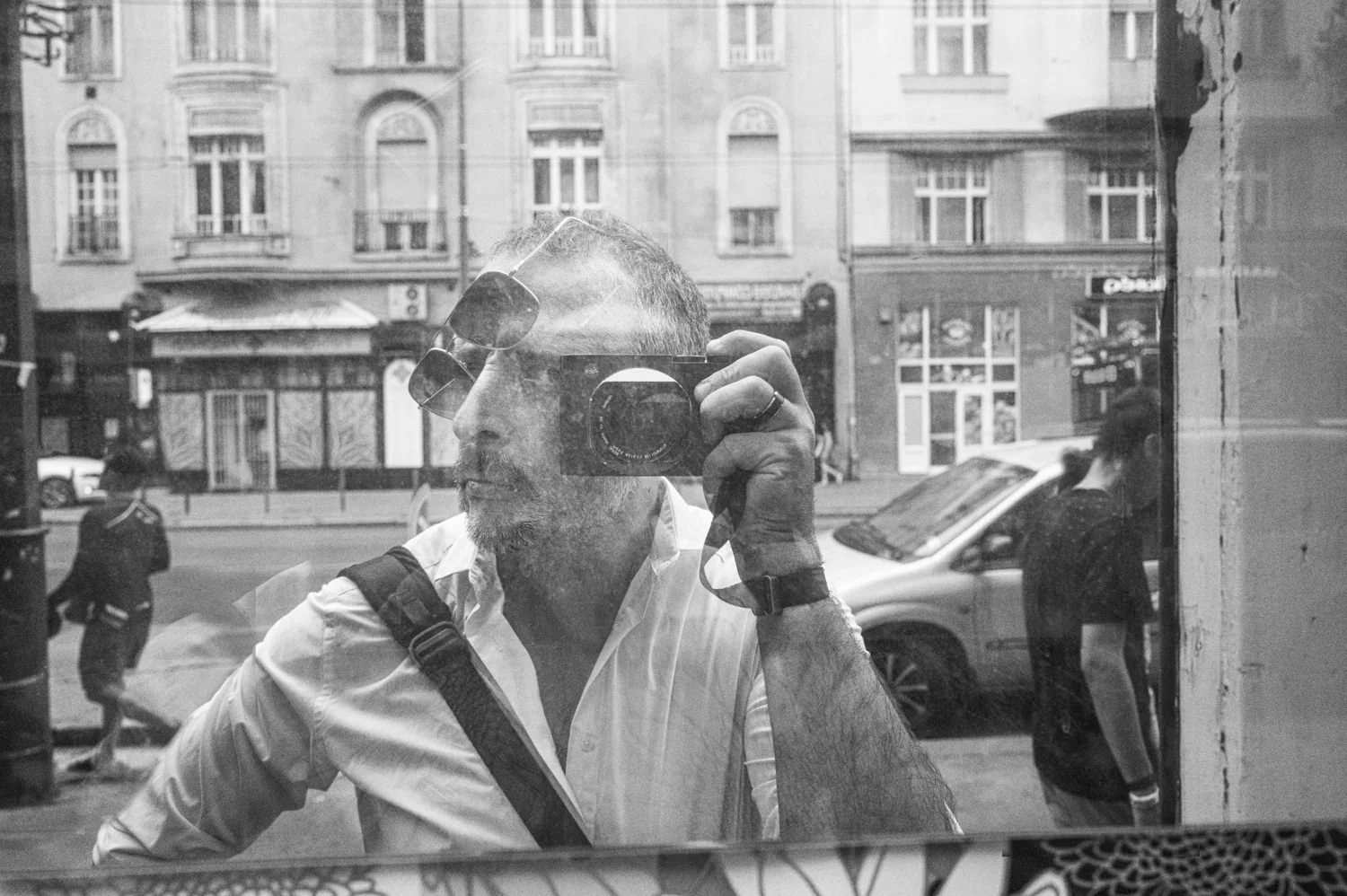
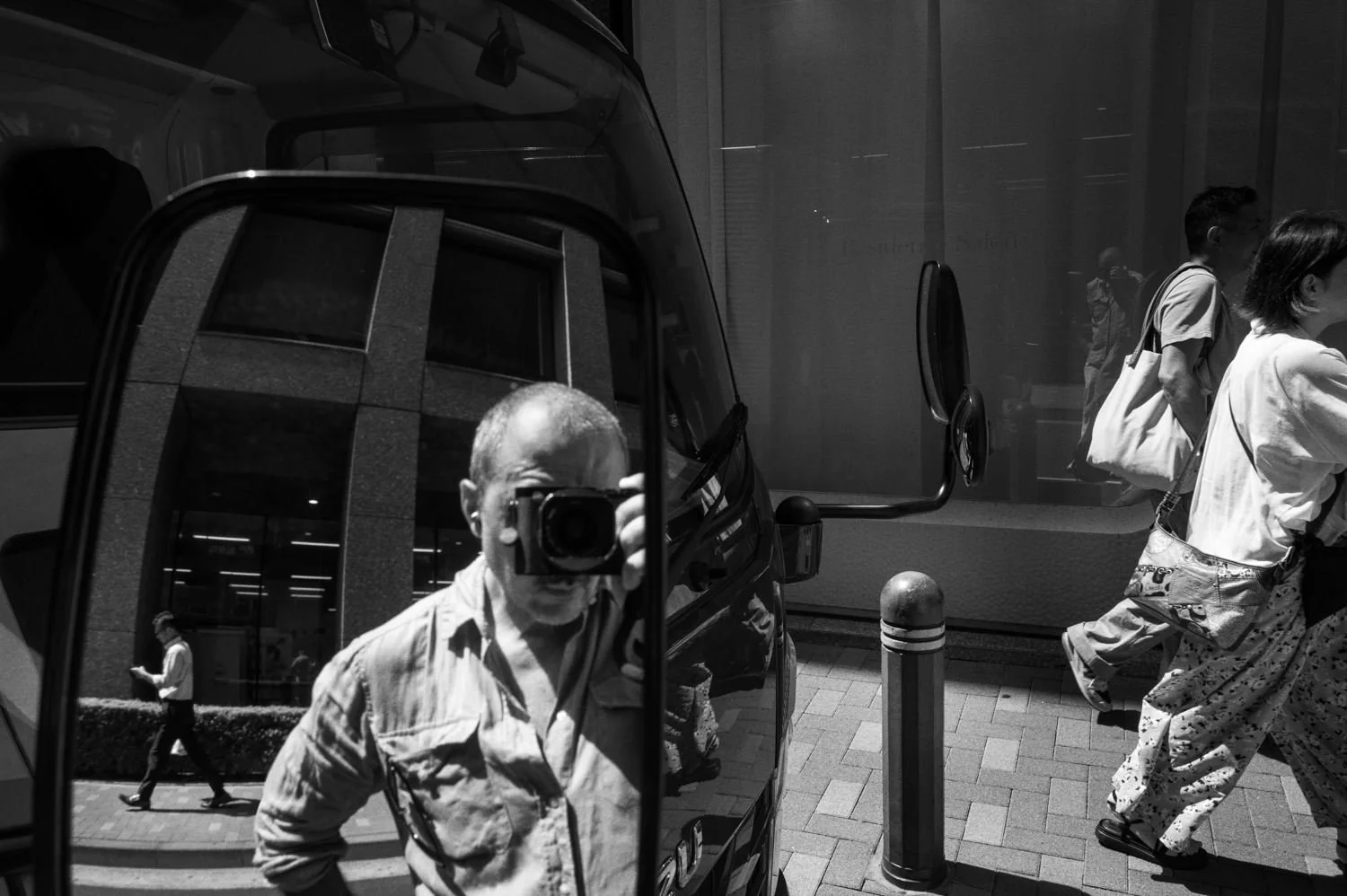
Working with reflections, shadows, and puddles requires a complete change of perspective – literally. You no longer look ahead in search of interesting scenes; you begin to look down, at shiny surfaces, at shadow zones. The city becomes a catalog of potential mirrors: shop windows, parked cars, puddles after rain, polished marble floors, even smartphone screens abandoned on café tables.
The puddle is perhaps the most democratic and poetic of all urban mirrors. It exists only temporarily, after rain, before sun or wind disperse it. It's imperfect, distorted by ripples, contaminated by leaves and debris. Yet precisely in this imperfection, it captures something truer than a perfect reflection. When I photograph myself in a puddle, I'm not documenting how I actually appear – I'm documenting how I feel in that specific moment, in that specific place, with that particular state of mind.
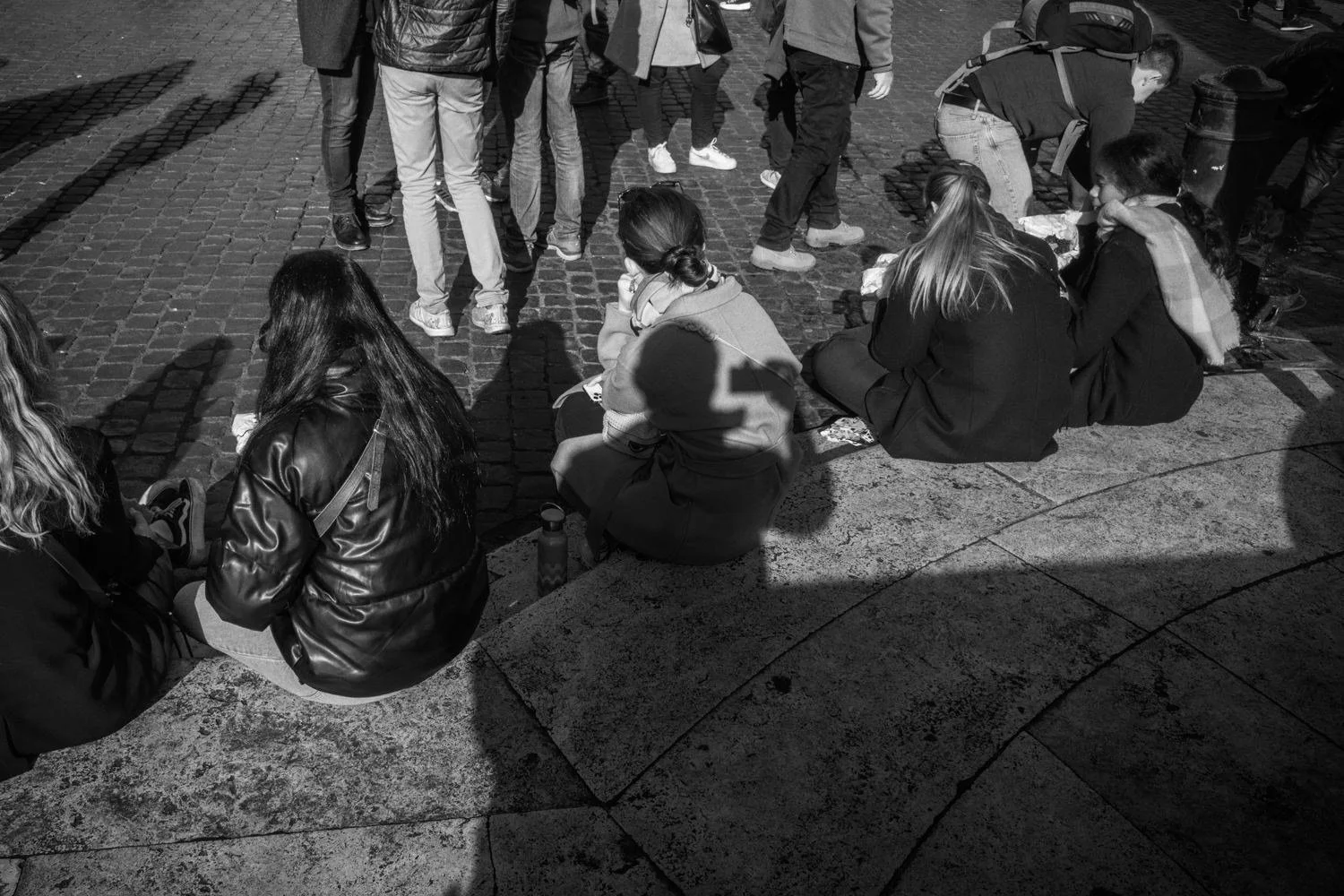
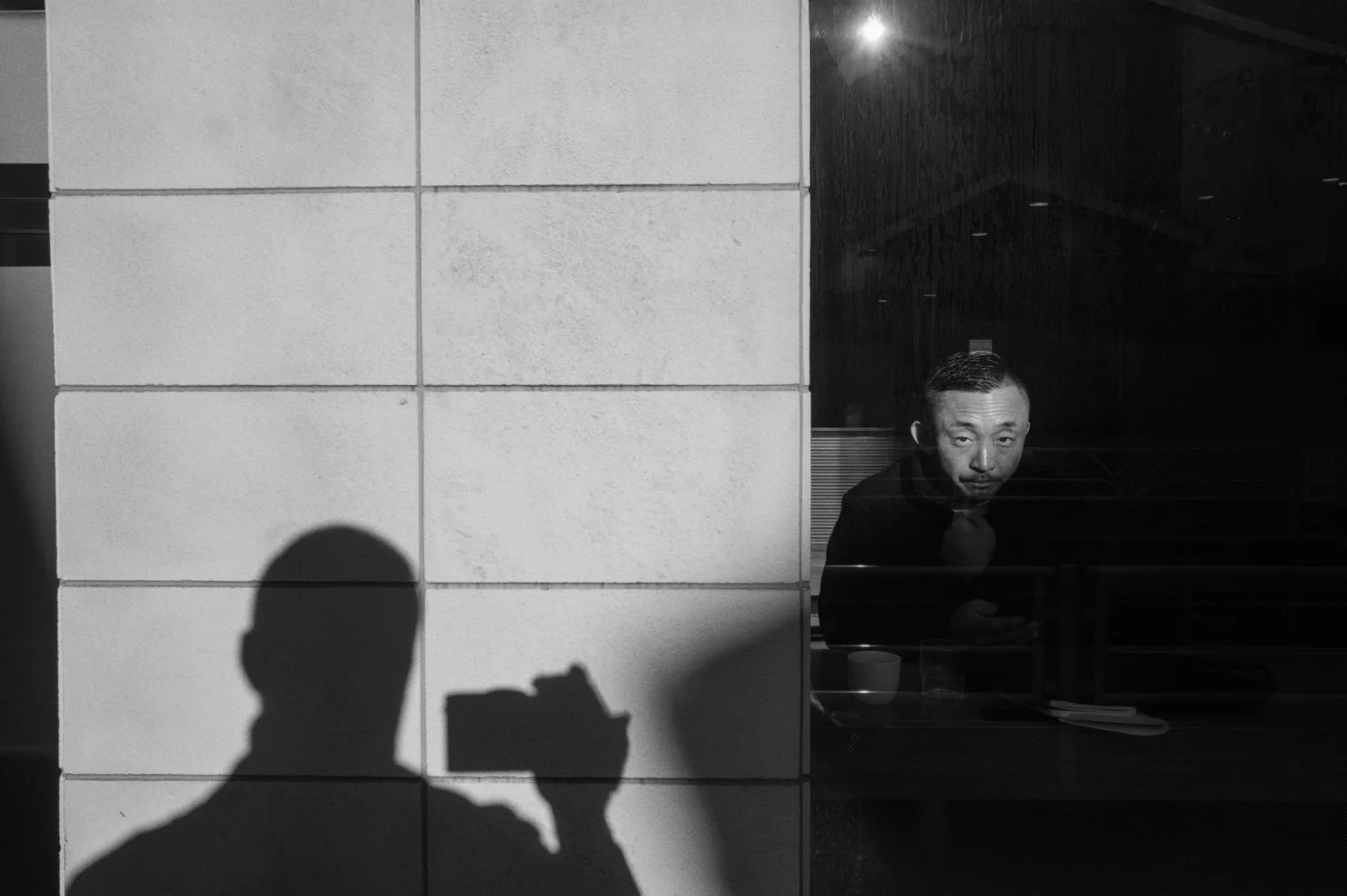
The shadow is even more evanescent. It changes with every hour of the day, stretches at sunset, shortens at noon, disappears on cloudy days. Photographing one's own shadow is like capturing a ghost – it's you, but not completely you. It's your presence reduced to the essential, to silhouette, to the absence of details. There's something liberating in this: in shadow, your age, your specific appearance, even your identity become secondary. Only the form remains, the gesture, the posture.
My Section
Looking at my collection of street self-portraits, I realize they constitute an involuntary visual diary. Not just of the cities I've traversed – Rome, Milan, New York, Moscow, Hong Kong – but also of my moods, my creative phases, my unresolved questions.
Some are playful, almost ironic: my reflection fragmented in a chrome surface, multiplied as in a hall of mirrors. Others are melancholic: a solitary shadow stretching across a deserted sidewalk at sunset. Some are accidental, captured almost unconsciously while working on something else. Others are deeply deliberate, the result of long waits for the right light, the perfect angle, the moment when all elements – shadow, reflection, urban context – converge in harmonious composition.
What these self-portraits have in common is a certain humility. They are not studied poses, not narcissistic celebrations. They are rather acknowledgments: "I am here, like any other passerby. The difference is that I've chosen to document this being here, this temporary presence in a space that existed before me and will continue to exist after."
An Invitation
I open this section not as a definitive statement, but as a work in progress. The street self-portrait is, by its nature, an endless project. As long as I walk the streets with a camera, as long as there are reflective surfaces and sunny days that cast shadows, there will be opportunities to capture a new fragment of this evolving relationship between myself and urban space.
I invite other photographers to explore this practice. Not to imitate Friedlander or Maier, but to find their own visual language, their own unique way of inserting themselves into the scene. Perhaps you'll discover, as I have, that the street self-portrait is not an act of vanity, but of vulnerability. It's not an assertion of "I," but a question: who am I in this moment, in this place, with this light?
And perhaps, as happens with the best self-portraits, the answer will never be definitive. But in the search itself, in walking the streets looking down at puddles and shadows, we'll find something equally precious: a way of being present, aware, alive in the moment.
All images from my self-portrait section are visible at: www.walkingphotographer.net/eolo-perfido-self-portraits-street-photography